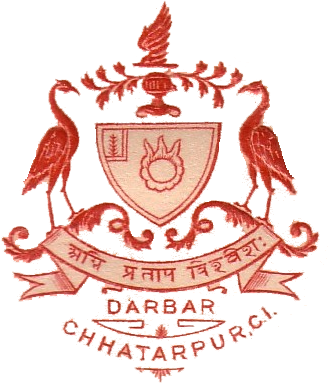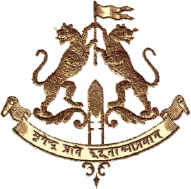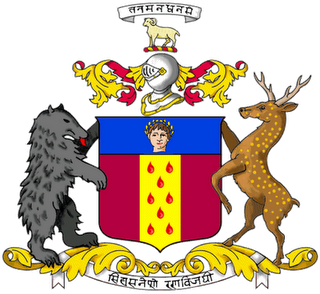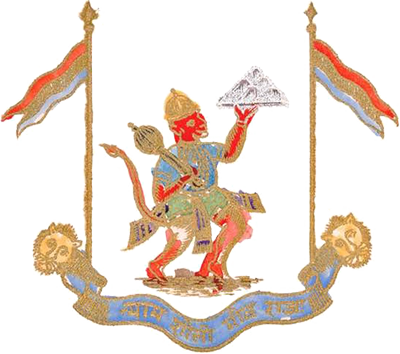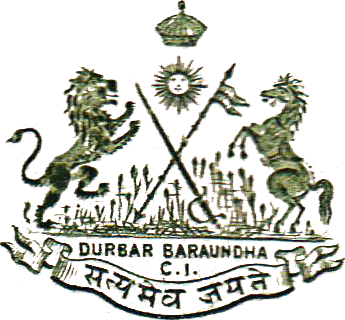
The Coat of Arms of Baraundha is the heraldic emblem of a princely state in the Bundelkhand & Baghelkhand region (present-day Madhya Pradesh / Uttar Pradesh). It represents the lineage, authority and identity of the ruling house that held it.
Historical Background
Baraundha, also known as Pathar Kachhar, was a princely state of the Bagelkhand Agency in Central India, in what is now Satna district of Madhya Pradesh. In 1892 it covered about 904 square kilometres with a population of 17,283. It was one of the oldest states of the region: tradition dates its foundation to 1169, making it older than most of the Bundela and Baghel states around it.
The Ruling House
The rulers of Baraundha belonged to the Raghuvanshi Rajputs, who claim descent from Raghu, the ancestor of Lord Rama. Their territory lay in the hilly country of the Vindhyas, close to the pilgrimage centre of Chitrakoot – the forest where, according to the Ramayana, Rama spent part of his exile – a connection that gave the Raghuvanshi house special pride in its locality.
Rulers of Baraundha
- Mohan Singh (1790–1827)
- Sarabjit Singh (1827–1867)
- Raghubar Dayal Singh (1874–1885), created Raja Bahadur in 1877
- Ram Pratap Singh (1886–1908) and Gaya Prasad Singh (1908–1933)
- Ram Pratap Singh (1933–1947), the last ruler
The Imperial Assemblage of 1877
Baraundha’s standing was confirmed at the Imperial Assemblage held at Delhi on 1 January 1877, the occasion on which banners bearing the arms of the Indian states were presented to their rulers. Raghubar Dayal Singh received the style of “His Highness”, the title Raja Bahadur and a hereditary salute of 9 guns – a high distinction for so small a state.
Accession
After Independence, Baraundha joined Vindhya Pradesh and later Madhya Pradesh. The Baraundha coat of arms commemorates a Raghuvanshi house that ruled its corner of the Vindhyas for centuries and was honoured at the great Delhi Assemblage of 1877.
History of the Emblem
European-style armorial bearings for the Indian princely states were largely formalised for the Imperial Assemblage held at Delhi in 1877, when banners bearing the arms of each state were presented to the rulers. The designs blended traditional Indian symbols – the sun and moon of the Suryavanshi and Chandravanshi lines, family deities, sacred animals, weapons and regalia – with the structure of Western heraldry. As a 9-gun salute state, Baraundha held a recognised place in the precedence of the princes of India. These arms remained in official use on seals, coins, stamps, buildings and state documents until the princely states acceded to India and Pakistan after 1947.
Reading the Coat of Arms
A typical Indian royal coat of arms is made up of a few traditional elements:
- Shield (escutcheon) – the central field carrying the principal symbols of the house.
- Crest – the device placed above the shield, often a crown, a deity, a bird or an animal.
- Supporters – figures on either side of the shield, frequently horses, lions, tigers, elephants or mythical beasts.
- Motto scroll – a banner below the shield bearing a motto or invocation, usually in Sanskrit, Hindi, Persian or a regional language.