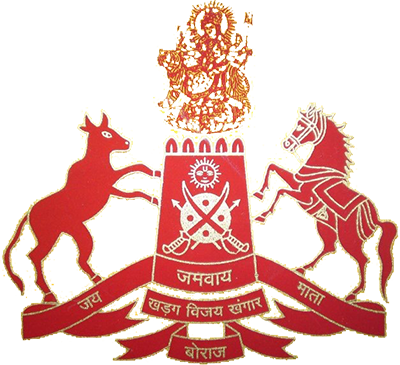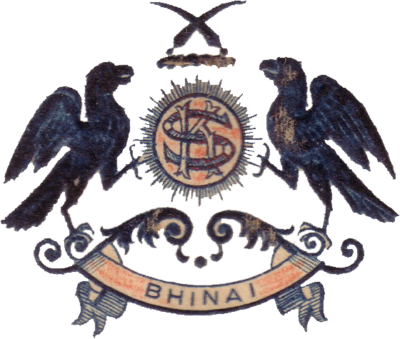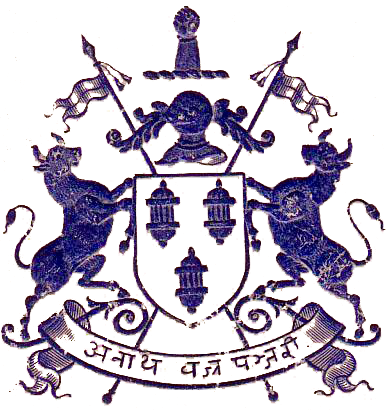
The Coat of Arms of Bari Sadri is the heraldic emblem of a thikana in the Rajputana region (present-day Rajasthan). It represents the lineage, authority and identity of the ruling house that held it.
Historical Background
Bari Sadri is a town in Chittorgarh district of southern Rajasthan. Until 1949 it was the seat of one of the sixteen great first-class estates (the “Solah Umrao”) of the kingdom of Mewar, and it was held by Rajputs of the Jhala clan, whose chief bore the distinctive title of Raj Rana.
From Halvad to Mewar
The Jhalas are an ancient Rajput clan of Kathiawar, whose senior branch ruled Halvad and later Dhrangadhra. In the early 16th century Ajja Jhala, a prince of the Halvad house who had lost his claim at home, came to Mewar with his followers. He was received by the Sisodia rulers and granted Bari Sadri, establishing a Jhala line that served the Maharanas for more than four centuries.
Ajja Jhala at Khanwa
Ajja Jhala’s fame rests on the Battle of Khanwa in 1527, fought between Rana Sanga of Mewar and the Mughal founder Babur. When Rana Sanga was wounded and carried from the field, Ajja took up the royal insignia and continued to lead the army as if he were the Maharana, giving his life in the battle. In gratitude the Maharanas granted his descendants the right to bear royal emblems and the honoured title of Raj Rana.
Jhala Manna at Haldighati
The Jhalas of Mewar repeated this act of devotion at the Battle of Haldighati in 1576. Jhala Manna (Bida Jhala), a kinsman of the Bari Sadri house, took the royal parasol from Maharana Pratap and drew the Mughal attack upon himself, allowing the wounded Maharana to escape. He fell on the battlefield, and his sacrifice is celebrated in Rajasthani ballads to this day.
The Estate
Bari Sadri remained one of the most honoured estates of Mewar, and its Raj Ranas held a high place in the Maharana’s court. Today it is a municipality of about 16,000 people, surrounded by the farmland and low hills of the Chittorgarh region.
The Coat of Arms
The Bari Sadri arms record a family whose loyalty to Mewar became legendary. They combine the heritage of the Jhala clan of Kathiawar with the solar symbolism of Mewar, reflecting the privileges granted to the house in recognition of its sacrifices at Khanwa and Haldighati.
History of the Emblem
From the late 19th century onward, many thikanas, talukas, jagirs and great estates followed the princely states in adopting heraldic achievements. These emblems were displayed on gateways, palace facades, carriages, silver, letterheads and seals, and often echoed the arms of the parent state or clan, adapted with family-specific symbols.
Reading the Coat of Arms
A typical Indian royal coat of arms is made up of a few traditional elements:
- Shield (escutcheon) – the central field carrying the principal symbols of the house.
- Crest – the device placed above the shield, often a crown, a deity, a bird or an animal.
- Supporters – figures on either side of the shield, frequently horses, lions, tigers, elephants or mythical beasts.
- Motto scroll – a banner below the shield bearing a motto or invocation, usually in Sanskrit, Hindi, Persian or a regional language.