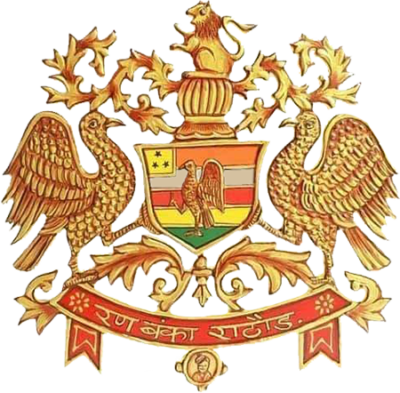
The Coat of Arms of Begun is the heraldic emblem of a thikana in the Rajputana region (present-day Rajasthan). It represents the lineage, authority and identity of the ruling house that held it.
Historical Background
Begun (Begu), in Chittorgarh district of south-eastern Rajasthan, was one of the premier first-class estates of Mewar, held by the Chundawat Sisodias. Its Rawats belonged to the most senior noble line of Mewar and traditionally led the Maharana’s armies.
The Sacrifice of Chunda
The Chundawats descend from Rao Chunda, eldest son of Rana Lakha of Mewar in the 15th century. When a marriage proposal intended for Chunda was accepted instead by his father, Chunda vowed that any son of the new marriage would inherit the throne, and he gave up his birthright. In return he and his descendants received special honours, and Begun, with Gothlai, became one of their estates. The Begun line counts twenty-three rulers.
Rawats of Begun
- Rawat Ratan Singh fought for Rana Sanga at the Battle of Khanwa against Babur in 1527.
- Rawat Saidas died defending Chittorgarh against Akbar in 1568.
- Rawat Kali Megh I (1578–1628) routed Mahabat Khan’s Mughal army in a night attack in 1608 and was later honoured by Jahangir; he built a Vishnu temple at Baghera.
- Rawat Devi Singh (1707–1740) was noted for his piety and sheltered the exiled Maharao Budh Singh of Bundi.
- Rawat Sawai Megh Singh II (1740–1804) received the title “Sawai”, rebuilt the fort walls and withstood a long siege by Mahadji Scindia.
The 20th Century
Under Rawat Sawai Anop Singh II (1890–1947) Begun saw the peasant movement of 1921–22, one of the early agrarian agitations of Rajasthan, after which the estate was placed under crown administration. Rawat Sawai Hari Singh II succeeded in 1948. In 1952 most of Begun’s eighteen forts were surrendered to the Government of India, the family retaining three.
Fort Begu Today
The family’s fort at Begun now welcomes guests as a heritage property. Its coat of arms reflects the Chundawat heritage of renunciation and martial service, one of the defining stories of Mewar.
History of the Emblem
From the late 19th century onward, many thikanas, talukas, jagirs and great estates followed the princely states in adopting heraldic achievements. These emblems were displayed on gateways, palace facades, carriages, silver, letterheads and seals, and often echoed the arms of the parent state or clan, adapted with family-specific symbols.
Reading the Coat of Arms
A typical Indian royal coat of arms is made up of a few traditional elements:
- Shield (escutcheon) – the central field carrying the principal symbols of the house.
- Crest – the device placed above the shield, often a crown, a deity, a bird or an animal.
- Supporters – figures on either side of the shield, frequently horses, lions, tigers, elephants or mythical beasts.
- Motto scroll – a banner below the shield bearing a motto or invocation, usually in Sanskrit, Hindi, Persian or a regional language.