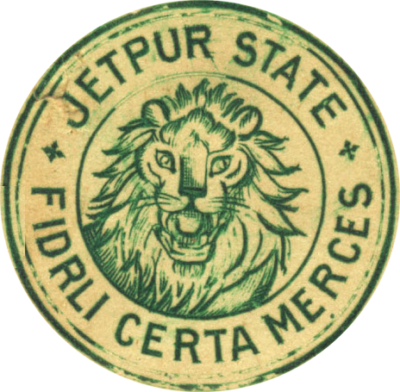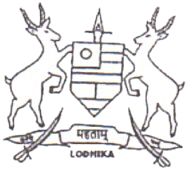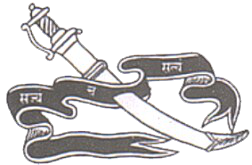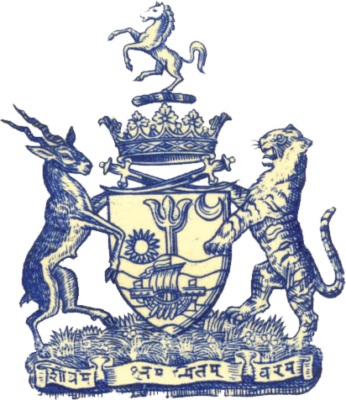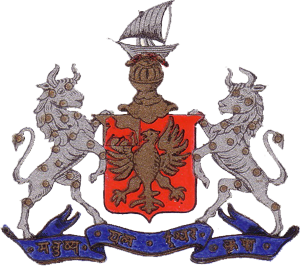
The Coat of Arms of Bhavnagar is the heraldic emblem of a princely state in the Kathiawar (Saurashtra) region (present-day Gujarat). It represents the lineage, authority and identity of the ruling house that held it.
Historical Background
Bhavnagar was one of the leading states of the Kathiawar Agency, ruled by the Gohil Rajputs and entitled to a 13-gun salute. It covered about 7,669 square kilometres along the Gulf of Khambhat, with a population of 618,429 in 1941.
From Sihor to Bhavnagar
The Gohils moved to the coast of Gujarat around 1260 and ruled successively from Sejakpur, Umrala and Sihor. In 1722–23 forces led by Khanthaji Kadani and Pilaji Gaekwad raided Sihor but were driven back by Maharaja Bhavsinhji Gohil. Concluding that Sihor was too exposed, Bhavsinhji founded a new capital in 1723 near the village of Vadva, about 20 kilometres away on the coast, and named it Bhavnagar after himself.
A Trading Port
Bhavnagar’s coastal site made it a busy port trading with Mozambique, Zanzibar, Singapore and the Persian Gulf. Bhavsinhji negotiated revenue-sharing agreements with the Sidis of Janjira and later with the British, and his grandson Vakhatsinhji greatly enlarged the state in the late 18th century. Bhavnagar became a British protectorate in 1807.
Reform and Railways
During the minority of Maharaja Takhtsinhji (r. 1870–1896), joint administration brought major reforms in revenue, administration and the ports. Bhavnagar built its own State Railway without financial aid from the central government, and the state became known for good governance and education.
Krishnakumarsinhji and Democracy
The last ruler, Maharaja Krishnakumarsinhji (r. 1919–1948), is remembered across India as one of the first princes to hand power to the people. In 1948 he transferred the administration to elected representatives and signed the accession to the Indian Union on 15 February 1948. He later served as the first Indian Governor of Madras.
The Motto
The state’s coat of arms bears the motto “Man proposes but God disposes”, an unusual English motto reflecting the outlook of a court that blended Rajput tradition with modern administration. The arms stand for a dynasty that founded a great port city and gave up its throne for Indian democracy.
“Man proposes but God disposes”
Motto
History of the Emblem
European-style armorial bearings for the Indian princely states were largely formalised for the Imperial Assemblage held at Delhi in 1877, when banners bearing the arms of each state were presented to the rulers. The designs blended traditional Indian symbols – the sun and moon of the Suryavanshi and Chandravanshi lines, family deities, sacred animals, weapons and regalia – with the structure of Western heraldry. As a 13-gun salute state, Bhavnagar held a recognised place in the precedence of the princes of India. These arms remained in official use on seals, coins, stamps, buildings and state documents until the princely states acceded to India and Pakistan after 1947.
Reading the Coat of Arms
A typical Indian royal coat of arms is made up of a few traditional elements:
- Shield (escutcheon) – the central field carrying the principal symbols of the house.
- Crest – the device placed above the shield, often a crown, a deity, a bird or an animal.
- Supporters – figures on either side of the shield, frequently horses, lions, tigers, elephants or mythical beasts.
- Motto scroll – a banner below the shield bearing a motto or invocation, usually in Sanskrit, Hindi, Persian or a regional language.