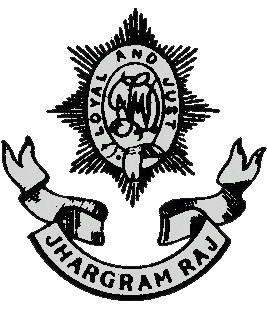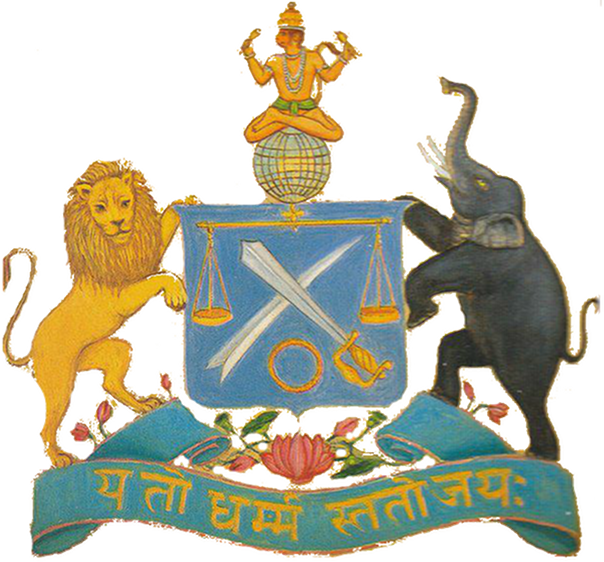
The Coat of Arms of Cooch Behar is the heraldic emblem of a princely state in the Bengal region (present-day West Bengal). It represents the lineage, authority and identity of the ruling house that held it.
Historical Background
Cooch Behar was a princely state in the north of Bengal, at the foot of the Himalaya and close to Bhutan. In 1901 it covered about 3,385 square kilometres. Its rulers, of the Koch dynasty, held the title of Maharaja from 1884 and enjoyed a 13-gun salute.
The Koch Kingdom
The Koch dynasty arose in the early 16th century as rulers of the Kamata kingdom, with its capital at Kamatapur. Under Maharaja Nara Narayan and his brother, the great general Chilarai, the Koch kingdom became one of the major powers of north-eastern India. After Nara Narayan’s death in 1586 the kingdom split, and the western portion became Koch Bihar – later Cooch Behar – with Lakshmi Narayan (1587–1621) as its first ruler. The capital moved to Cooch Behar town in 1693.
Mughals, Bhutan and the British
The Mughals reduced Cooch Behar to a vassal state in 1609. Later it fell under Bhutanese influence, until in 1773 the ruler sought help from the East India Company against Bhutan and became a British protectorate.
Maharaja Nripendra Narayan
The most famous ruler was Maharaja Nripendra Narayan (1863–1911), who modernised the state, built the grand Cooch Behar Palace (Victor Jubilee Palace) modelled on Buckingham Palace, and founded schools and colleges. His wife, Maharani Suniti Devi, was the daughter of the Brahmo reformer Keshub Chandra Sen and a pioneer of women’s education. Their granddaughter, Gayatri Devi, became Maharani of Jaipur.
Merger
Cooch Behar acceded to India and became a district of West Bengal in 1950. The palace is now a museum. The Cooch Behar coat of arms represents the Koch dynasty, one of the great royal houses of the eastern Himalayan region.
History of the Emblem
European-style armorial bearings for the Indian princely states were largely formalised for the Imperial Assemblage held at Delhi in 1877, when banners bearing the arms of each state were presented to the rulers. The designs blended traditional Indian symbols – the sun and moon of the Suryavanshi and Chandravanshi lines, family deities, sacred animals, weapons and regalia – with the structure of Western heraldry. As a 13-gun salute state, Cooch Behar held a recognised place in the precedence of the princes of India. These arms remained in official use on seals, coins, stamps, buildings and state documents until the princely states acceded to India and Pakistan after 1947.
Reading the Coat of Arms
A typical Indian royal coat of arms is made up of a few traditional elements:
- Shield (escutcheon) – the central field carrying the principal symbols of the house.
- Crest – the device placed above the shield, often a crown, a deity, a bird or an animal.
- Supporters – figures on either side of the shield, frequently horses, lions, tigers, elephants or mythical beasts.
- Motto scroll – a banner below the shield bearing a motto or invocation, usually in Sanskrit, Hindi, Persian or a regional language.