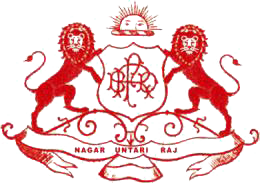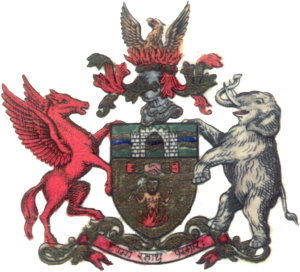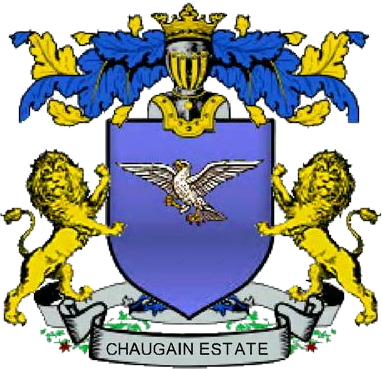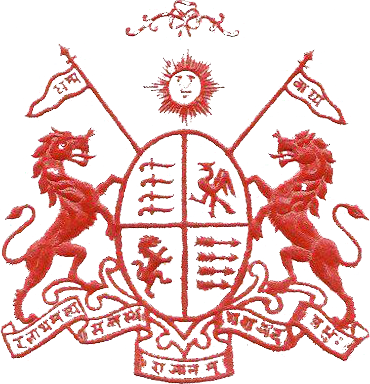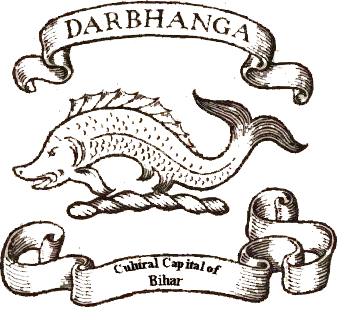
The Coat of Arms of Darbhanga is the heraldic emblem of an estate (zamindari / taluqdari) in the Bihar & Jharkhand region (present-day Bihar / Jharkhand). It represents the lineage, authority and identity of the ruling house that held it.
Historical Background
Raj Darbhanga was the largest and richest of the zamindari estates of north Bihar, ruled by the Khandwala dynasty of Maithil Brahmins in the Mithila region. At its height the estate covered more than 4,000 square miles and around 4,500 villages.
Foundation
According to tradition, the Mughal emperor Akbar named Mahesh Thakur ruler of Mithila on Ram Navami in 1557. A firman of Aurangzeb in 1684 made the family’s lands private property, and the Raj became a semi-independent chieftainship.
Notable Rulers
- Raja Narendra Singh (1740–1760) fought to free Mithila from the control of Mughal Bengal.
- Maharaja Lakshmeshwar Singh (1860–1898), a philanthropist, founded the Tirhut Railway in 1874.
- Maharaja Rameshwar Singh (1898–1929), a patron of Hindu learning and Tantric publishing.
- Maharaja Kameshwar Singh (1929–1962), founder of the Mithila Sanskrit Research Institute and a member of Parliament.
Patrons of Learning
The Darbhanga family made major donations to Banaras Hindu University, Calcutta University, Aligarh Muslim University and Patna University, and helped found Darbhanga Medical College. The royal complex at Darbhanga now houses Lalit Narayan Mithila University and Kameshwar Singh Darbhanga Sanskrit University. During the India–China war of 1962 the family donated about 15 maunds of gold to the government.
Palaces and Music
The family built Nargona Palace, Lakshmivilas Palace, the walled Darbhanga Fort and the Rajnagar palace complex, as well as Darbhanga House in Shimla. The Raj was a great patron of Dhrupad music, and the Darbhanga gharana is one of its three major schools.
After 1947
With the abolition of zamindari after Independence the estate declined. Maharaja Kameshwar Singh died in 1962 without a direct successor. The Darbhanga coat of arms embodies the cultural heritage of Mithila and one of the greatest landed houses of India.
History of the Emblem
From the late 19th century onward, many thikanas, talukas, jagirs and great estates followed the princely states in adopting heraldic achievements. These emblems were displayed on gateways, palace facades, carriages, silver, letterheads and seals, and often echoed the arms of the parent state or clan, adapted with family-specific symbols.
Reading the Coat of Arms
A typical Indian royal coat of arms is made up of a few traditional elements:
- Shield (escutcheon) – the central field carrying the principal symbols of the house.
- Crest – the device placed above the shield, often a crown, a deity, a bird or an animal.
- Supporters – figures on either side of the shield, frequently horses, lions, tigers, elephants or mythical beasts.
- Motto scroll – a banner below the shield bearing a motto or invocation, usually in Sanskrit, Hindi, Persian or a regional language.