By India Royal Families
On 9 June each year, we remember Maharaja Umaid Singh of Jodhpur, one of the most remarkable rulers of princely India. His reign, spanning from 1918 to 1947, coincided with a period of immense political, economic, and social change. While many princes are remembered for their palaces and pageantry, Umaid Singh earned a more enduring distinction: he sought to modernize his state while remaining deeply committed to the welfare of his people.
His untimely passing on 9 June 1947, barely two months before India’s Independence, marked the end of an era not only for Jodhpur but for princely India itself.
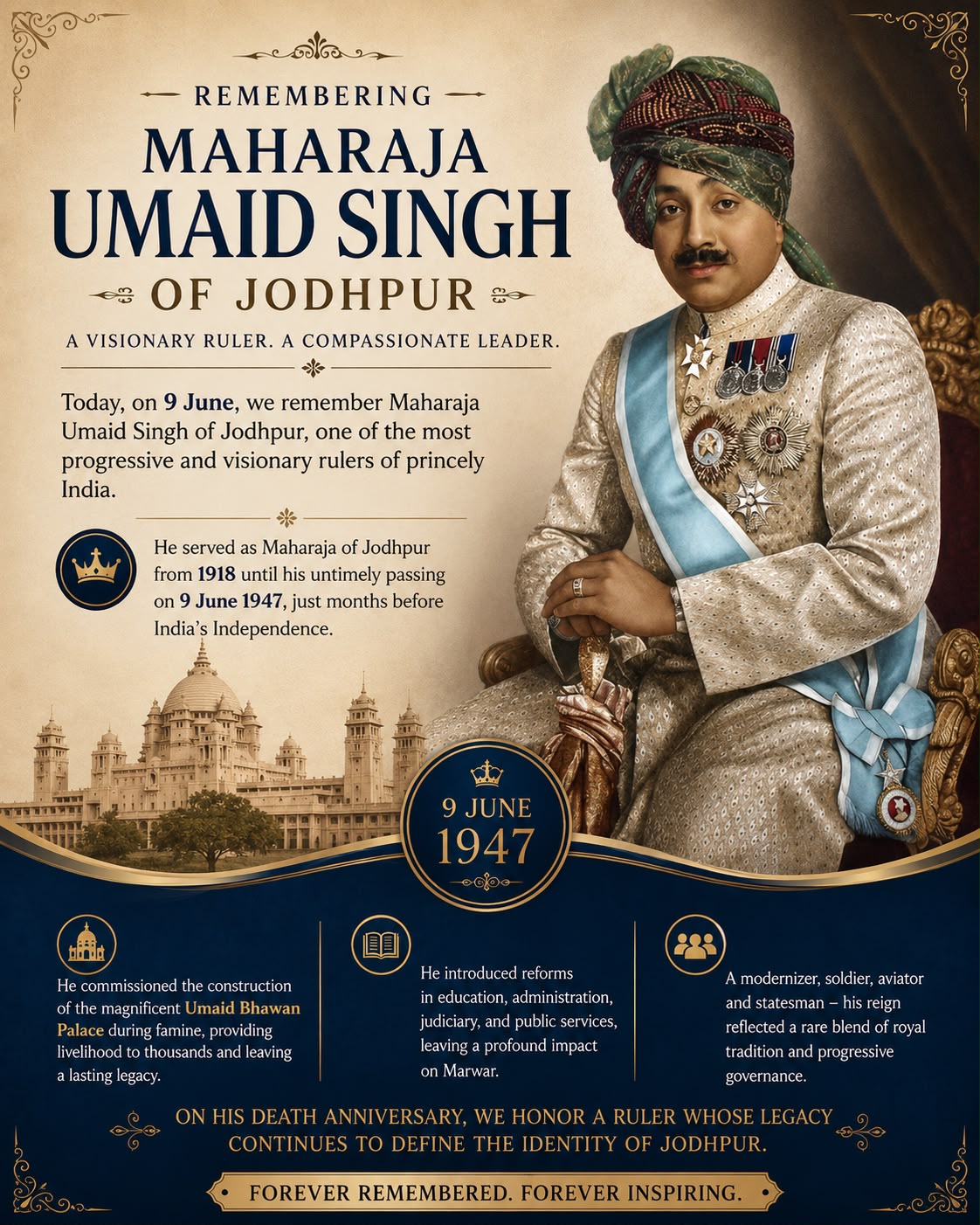
A Young Maharaja in a Changing World
Born on 8 July 1903, Umaid Singh ascended the throne of Jodhpur in 1918 following the death of his father, Maharaja Sardar Singh. He inherited one of the largest and most influential princely states in Rajputana at a time when India was witnessing growing political consciousness and demands for reform.
Educated in the traditions of Rajput statecraft while remaining receptive to modern ideas, the young ruler understood that the future of a princely state depended not merely on preserving heritage but on adapting to changing realities.
Throughout his reign, he worked to strengthen administration, improve public services, and encourage development across Marwar.
The Palace That Was Built to Fight Famine
Perhaps no monument is more closely associated with Maharaja Umaid Singh than the magnificent Umaid Bhawan Palace, one of the last great royal palaces built in India.
Yet the palace’s story is not simply one of royal grandeur.
During the late 1920s and early 1930s, Marwar was struck by severe drought and economic hardship. Thousands faced unemployment and uncertainty. In response, Maharaja Umaid Singh initiated the construction of Umaid Bhawan Palace as a large-scale public works project.
The objective was straightforward yet profound: provide employment to the people of Jodhpur during difficult times.
For years, thousands of labourers, craftsmen, stone-cutters, and artisans found work through the project. The palace thus became not only an architectural masterpiece but also a symbol of compassionate governance.
Today, while visitors admire its imposing sandstone façade and Art Deco influences, the palace stands as a reminder of a ruler who sought practical solutions to human suffering.
A Modernizer and Reformer
Maharaja Umaid Singh believed that good governance required more than ceremonial authority. During his reign, efforts were made to modernize various aspects of administration and public life.
Education received increased attention, infrastructure expanded, and administrative systems became more efficient. Public institutions were strengthened, and reforms were introduced in areas ranging from governance to judicial administration.
He also encouraged the development of transportation and communications, helping connect the vast regions of Marwar more effectively.
These initiatives reflected a broader vision: a princely state that embraced progress while remaining rooted in its traditions.
Soldier, Sportsman, and Aviator
Like many Rajput rulers, Umaid Singh possessed a deep sense of martial tradition. However, he was equally fascinated by modern technology and innovation.
He developed a keen interest in aviation during an era when flying still represented the frontier of human achievement. This fascination reflected his larger outlook—an openness to new ideas and technological advancement.
He was also known for his sporting interests and represented the ideal of the modern Indian prince: confident in tradition yet engaged with the contemporary world.
The Final Years
The final years of Maharaja Umaid Singh’s reign coincided with dramatic political developments across India. The future of the princely states was becoming increasingly uncertain as Independence approached.
On 9 June 1947, Maharaja Umaid Singh passed away unexpectedly in Switzerland, where he had travelled for health reasons. He was only forty-three years old.
His death occurred at a pivotal historical moment, just weeks before the end of British rule in India. The responsibility of guiding Jodhpur through the transition to Independence would ultimately fall to his successor, Maharaja Hanwant Singh.
A Legacy That Endures
More than seven decades after his passing, Maharaja Umaid Singh remains one of Jodhpur’s most respected rulers.
His legacy survives not only in the grandeur of Umaid Bhawan Palace but also in the institutions he strengthened, the reforms he championed, and the welfare-oriented approach he brought to governance.
At a time when many rulers are remembered for displays of wealth and power, Umaid Singh is remembered for something far more meaningful: his determination to use authority in service of his people.
As we mark his death anniversary, we pay tribute to a visionary monarch whose reign helped shape modern Jodhpur and whose example continues to inspire students of Indian royal history.
Forever remembered as the builder of modern Marwar, a compassionate ruler, and one of the most progressive princes of twentieth-century India.