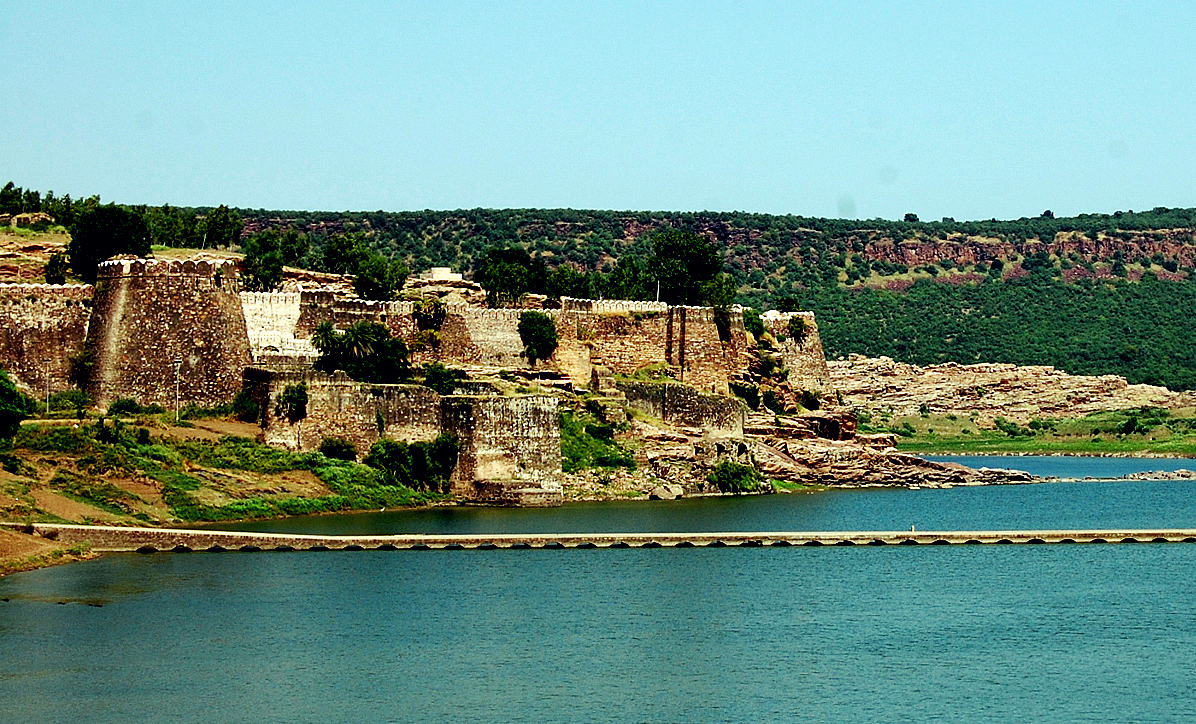
At Gagron Fort in Rajasthan’s Jhalawar district, the ramparts follow a rocky ridge above the meeting of the Ahu and Kali Sindh rivers. Water wraps around three sides of the stronghold. That setting explains why Gagron is described as both a hill fort and a water fort, or jal durg.
How the Ahu and Kali Sindh shaped the fort
The rivers constrained where an approaching force could reach the walls, while the ridge raised the defences above the surrounding land. From a viewpoint where the ground falls away, trace the line the walls take along the rock. The fort’s long, narrow shape makes more sense once you see how little space there is between the ridge and the rivers below.
The Khinchi Rajputs and the contest for Gagron
Gagron is associated with the Khinchi Rajputs. Rajasthan’s state education board records the defeat of the Khinchi ruler Achaldas by Hoshang Shah of Malwa. The episode places Gagron within a wider struggle over strongholds along the Rajasthan–Malwa frontier. Today the shrine of the Sufi saint Mitheshah near the fort offers another way to read the landscape, through the religious traditions of the settlement that grew beside it.
Why UNESCO included Gagron among the Hill Forts of Rajasthan
UNESCO inscribed Gagron in 2013 as part of a group of six forts with Chittorgarh, Kumbhalgarh, Ranthambore, Amber and Jaisalmer. Together they show how Rajput states adapted fortifications to the terrain. At Gagron, the clearest example is the confluence. The rivers and ridge help explain the position of the walls, the approaches to the fort and the views from its ramparts.
Visiting Gagron Fort from Jhalawar
Use Jhalawar as your starting point and allow enough time to see the fort from outside as well as within. At the approach, look back for a view of the ramparts against the ridge. Inside, pause at an open viewpoint to pick out the direction of each river. If you are also visiting the shrine, check local access and opening arrangements before setting out.
Watch UNESCO New Delhi’s tour of Gagron Fort
Sources include the UNESCO World Heritage Centre, India Cine Hub and the Rajasthan Board of Secondary Education.